Most artisanal and small-scale gold operations run on paper logs and intuition. Our plan is to instrument the operation with systematic data collection from the first day of production, and use that data to run it better.
Planned for Production Start · Not Yet Live
The Gap
Small-scale mining runs on intuition, not data.
Across most small-scale and artisanal gold operations, decisions about equipment maintenance, crew scheduling, and process settings are made by experienced hands, on instinct, with results tracked on paper or not tracked at all. That knowledge is real and valuable. It's also fragile, hard to transfer, and impossible to systematically improve.
Systematic data collection at this scale is uncommon, not because the technology is hard, but because nobody has built it into an operation this size before. We think that's an opening, not a limitation.
The Plan
Instrumenting the operation from day one.
Once production begins, we plan to log structured data at every stage of the process, not just aggregate monthly output, but the granular detail that makes the data useful for prediction and optimization.
⛏️
Shaft & Extraction
Tonnage extracted, per shaft, per day
Shift hours and crew size
Downtime events and stated cause
⚙️
Crushing & Milling
Tons processed per crusher, per day
Runtime vs. idle and downtime hours
Maintenance events and hours since last service
🧪
Recovery & Leach
Throughput and cycle time per batch
Reagent consumption per batch
Recovered grade output per batch
What It Enables
From logbook to applied model.
01
Predictive Maintenance
Runtime hours and breakdown history, logged consistently, are enough to start flagging equipment that's approaching a likely failure window before it happens. This starts simple and gets more accurate the longer the operation runs.
02
Process Optimization
Correlating process settings, feed rate, reagent dosage, cycle time, against actual recovered grade lets us tune the operation empirically over time, instead of relying solely on static planning assumptions.
03
Real Numbers, Not Just Modeled Ones
Our current financial model is built on regional benchmarks and planning assumptions, disclosed as such. Production data lets us eventually replace modeled recovery and throughput figures with our own operating history.
04
Institutional-Grade Operating Discipline
A clean, structured operating history is also exactly what due diligence for Phase III and Phase IV capital looks for, an operation that can show its work, not just its projections.
Built By
A technical founder's project.
This isn't an outsourced feature. Joshua Eaton, Archimidas's Founder and Managing Director, holds a background in computer science and has designed the data architecture personally, the same discipline he applies to deal structuring and financial modeling, applied to the operation itself.
💻
Planned Architecture
A mobile, offline-first logging layer for field data capture on site in Chunya District, syncing to a central database once connectivity is available. Built to work in a low-connectivity environment first, analytics second.
Interface Preview
Early design work on the field tool.
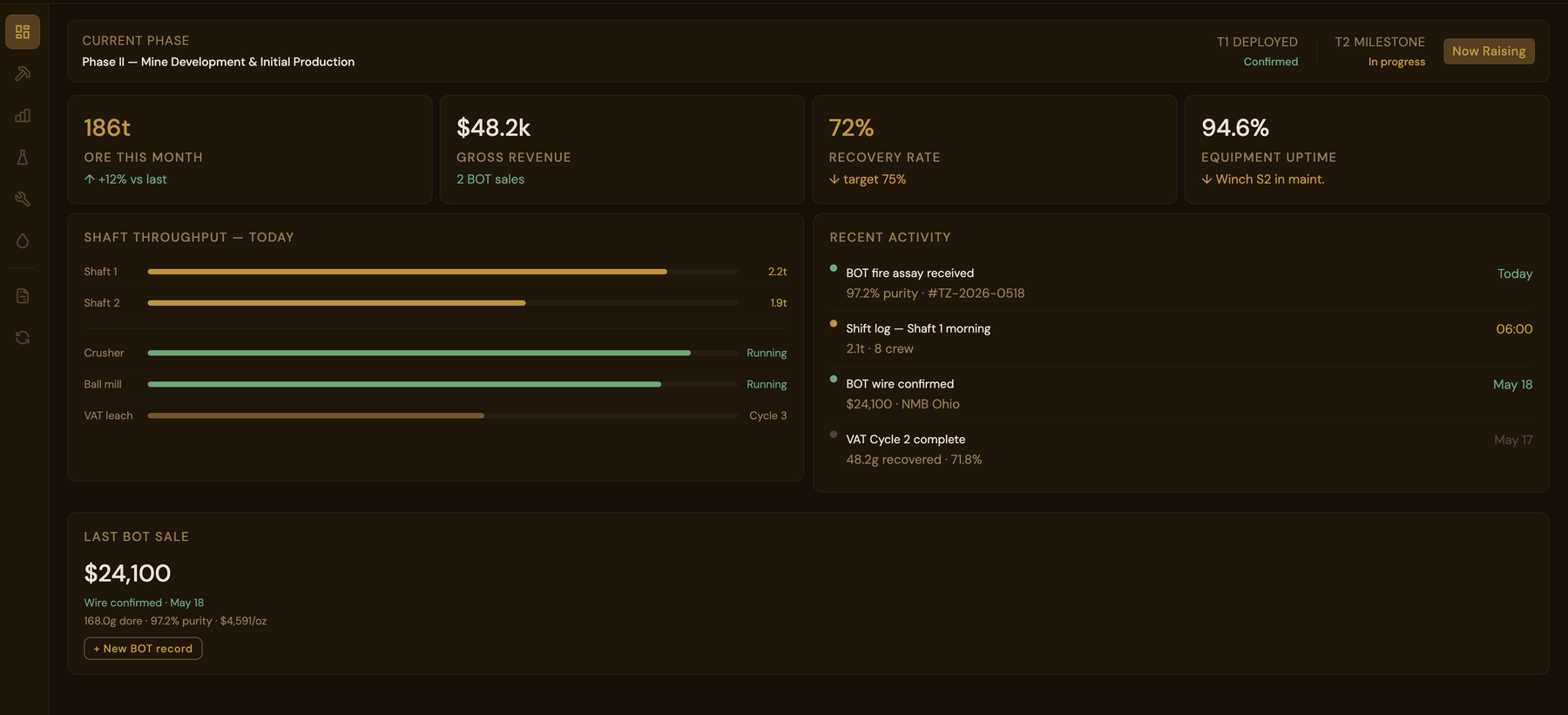
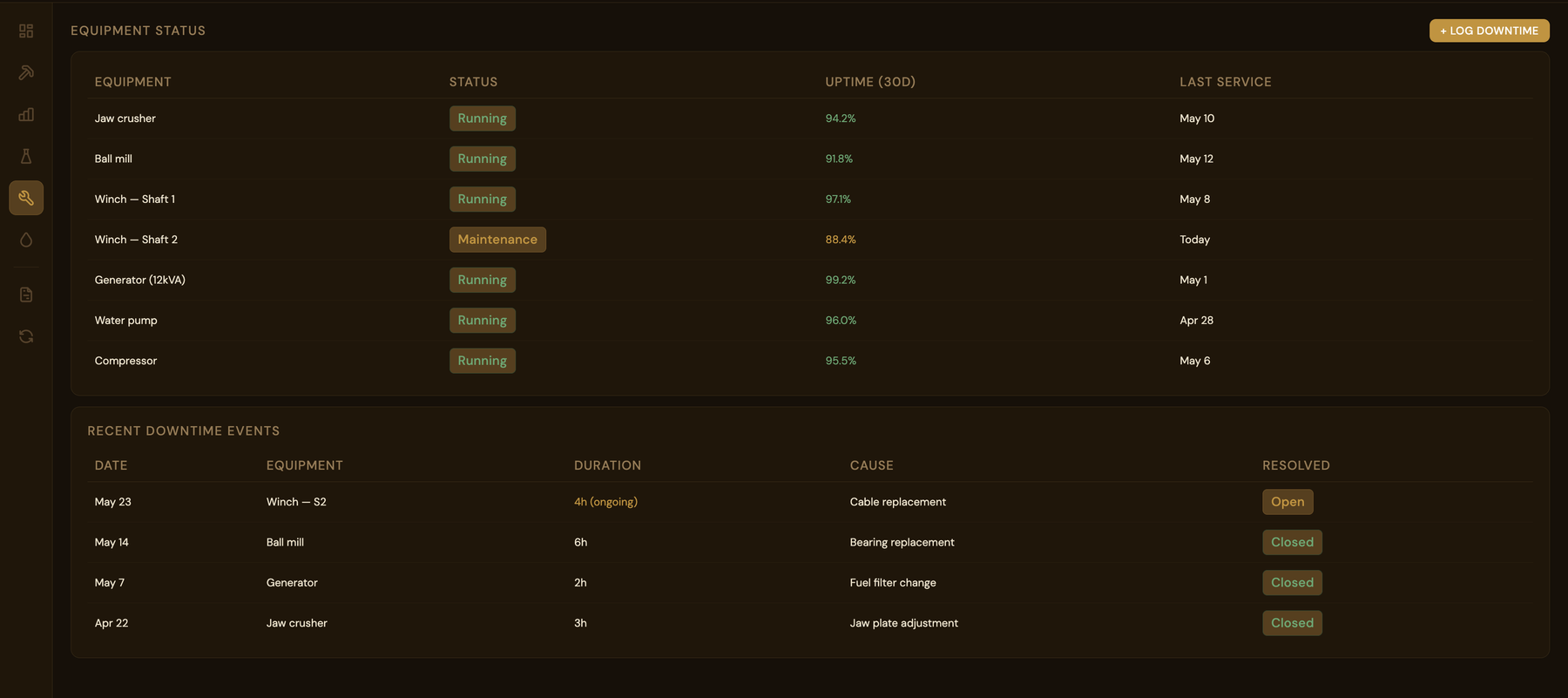
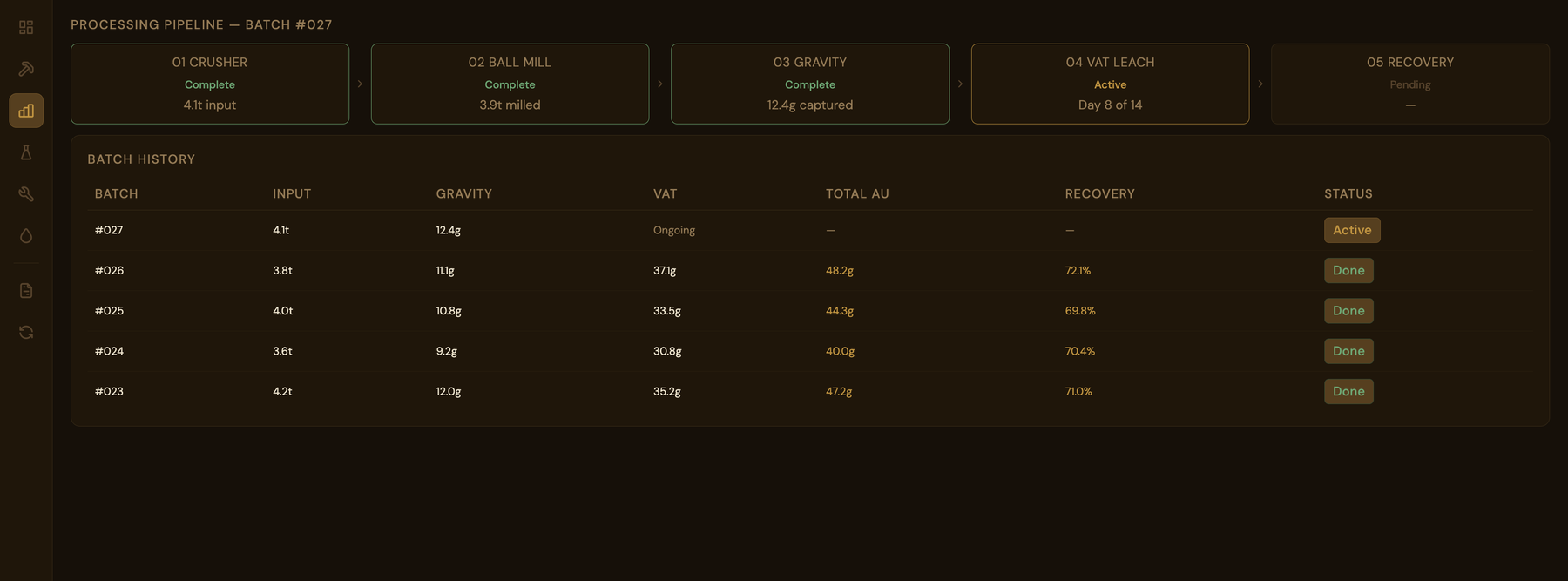
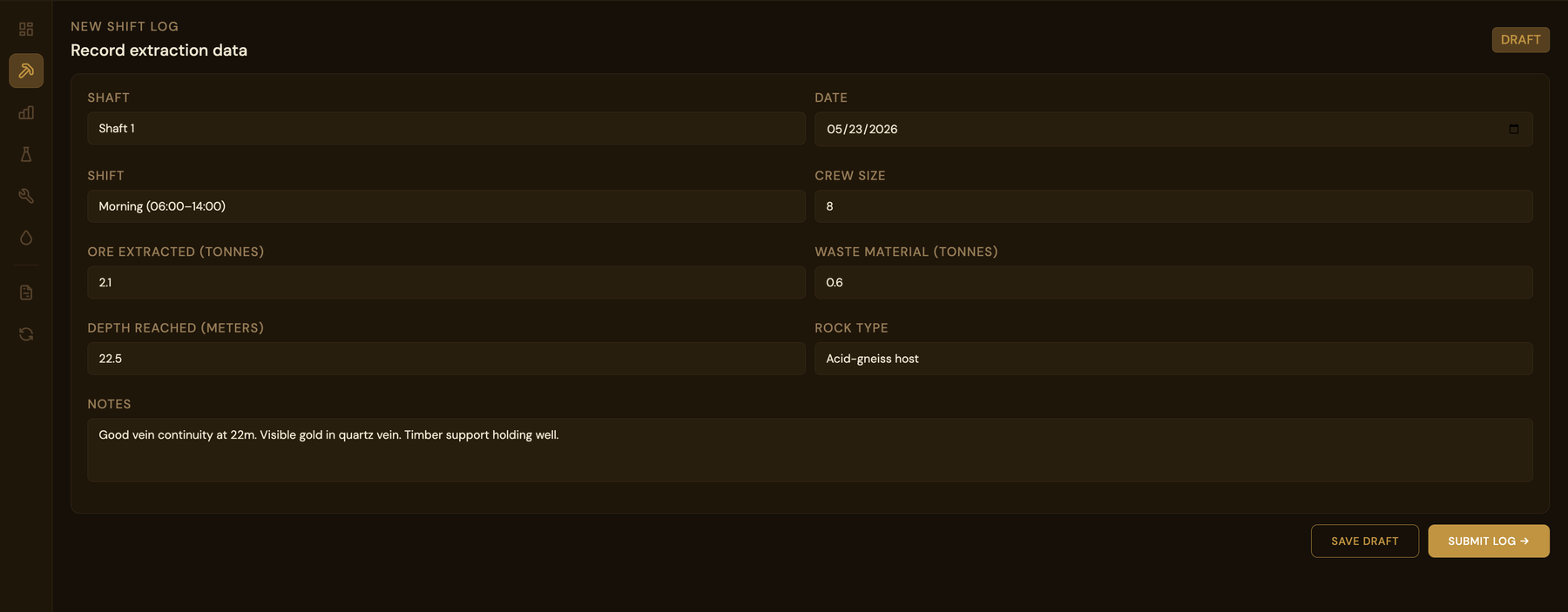
These are early interface mockups for the operator-side logging tool, screens for daily extraction records, processing batch tracking, and equipment monitoring. Design work is underway; this is not a live or functioning system yet.
Field data capture: ore extracted, depth, crew, rock type, per shift
Processing Pipeline
Batch tracking through crush, mill, gravity, VAT leach, and recovery
Equipment Status
Uptime tracking and downtime event logging, the base layer for predictive maintenance
Roadmap
Where this stands today.
●
Data schema designed
Shaft, crusher, and recovery-level logging structure defined.
Field logging tool built
Offline-first mobile capture tool for on-site data entry.
Data collection begins
Starts with first production, building a clean operating history from day one.
Predictive maintenance & optimization models
Applied once sufficient operating history exists to make them meaningful.
This page describes a plan, not a system that is currently running. Production has not yet started; construction of our first mine shaft is underway. We're publishing the plan now because we think the approach itself, applying this level of operational data discipline at small scale, is worth being transparent about before it's built, not just after.